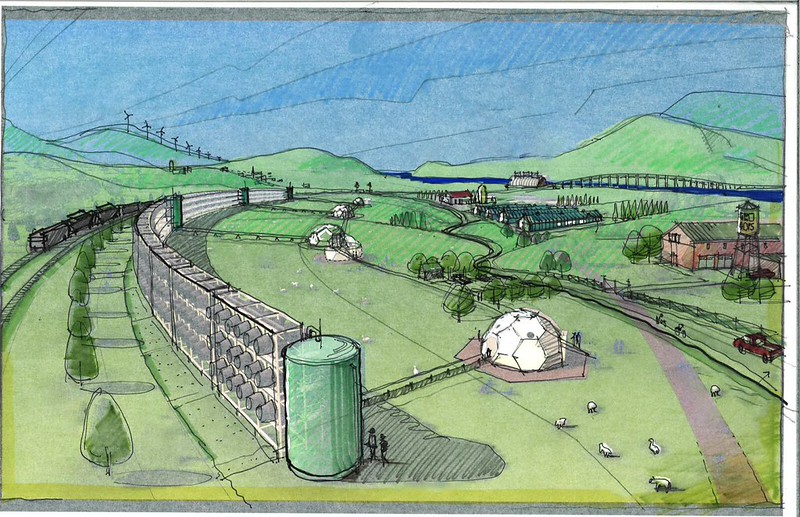
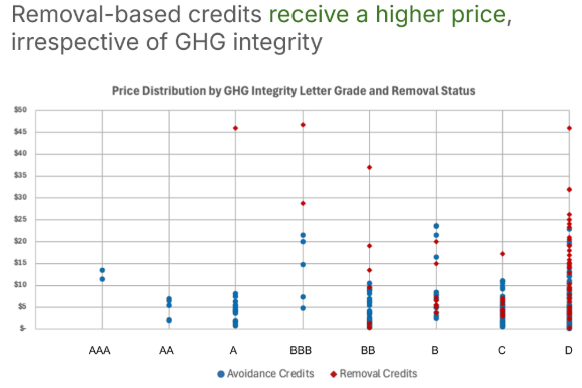
The carbon market has long treated "Carbon Dioxide Removal" as the gold standard — but that's changing. With SBTi's Version 2.0 now centering verified mitigation outcomes over project labels, and data showing avoidance credits outperforming removal credits in quality ratings, the CDR premium is a myth worth busting. A ton is a ton — what matters is proof.
Predict mitigation outcomesPart 3 of 5 | Previously: Inflated Baselines
Reading time: ~3-5 minutes
In September 2023, Bill Gates states, "Are we the science people or are we the idiots?" while arguing in favor of technological solutions to carbon dioxide and disparaging tree planting. With a focus on technological ("engineered") carbon solutions that Gates' statement embodied, Microsoft begins ratcheting up their purchases of advance carbon credit contracts for CDR - Carbon Dioxide Removal. In two years, Microsoft's carbon purchases are 9x their 2023 volumes, vacuuming up projects labeled "carbon removal" left and right, with a heavy focus on technological solutions. In late 2025 and early 2026, Bill Gates's reputation starts to crumble after his divorce proceedings and the Epstein Files. Late this April, LinkedIn feeds buzz with rumors as Microsoft pauses new carbon removal purchases. Microsoft is no longer the leader it once was of the voluntary carbon market.
The "CDR is better" myth still exists. Microsoft is a big reason why. Microsoft's spend in the market was tremendous, and it warped the market around carbon removal. Microsoft's spend was tremendous in part because carbon removal technology is immature and unproven, and because it's immature and unproven, it's also very expensive. And yet, a dollar spent on direct air capture (DAC) still has has a 10% of the impact on a dollar spent in reforestation. But those 10x dollars spent on DAC are a 10x investment in the carbon market and 10x the "market share".
Last week at Trellis Impact, I asked a few members of CDR coalitions a simple question:
Why is your future portfolio "Removals Only"? Why not invest in high quality reductions and avoidance projects with similar or better ratings?
This answer illustrates the new trend emerging in the market: "Microsoft sent a huge market signal that we followed, and now I'm questioning whether that still makes sense for us".
Calyx Global has done consistent, good research comparing carbon removal and carbon avoidance credits. They found that durability drives higher prices, not "carbon removal" labels. One of the primary risks in carbon removal projects is failing to properly account for the embodied emissions of the technology, and another risk is market-based additionality. Junk-rated carbon removal projects are a real risk in the carbon market, and relying on a "removal" label to signal quality is a dangerous way to buy carbon credits.
Last week, the Science-Based Targets Initiative (SBTi) published version 2.0, with a small but mighty update that can change the voluntary carbon market forever. Enter Verified Mitigation Outcomes, exit Carbon Dioxide Removal.
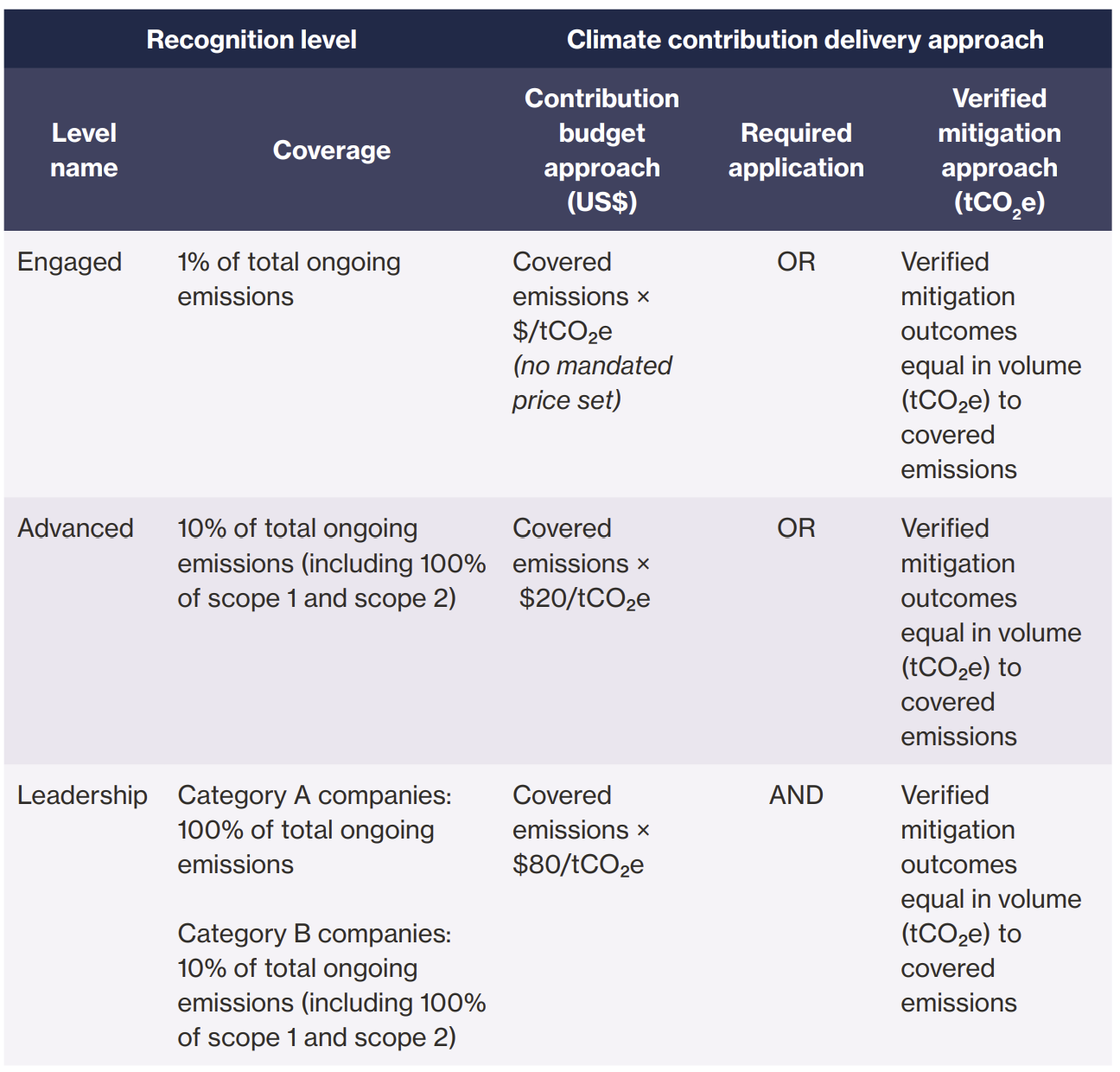
SBTi is been primary market driver for carbon credit purchases. Version 2.0 updates the Ongoing Emissions Responsibility, which recognizes companies for greenhouse gas mitigation beyond their internal emissions reductions targets. This responsibility to mitigate ongoing emissions was the main reason to buy carbon credits for many corporations, and version 1 specified Carbon Dioxide Removal. Now, Version 2.0 explicitly states:
By covering a defined share of these ongoing emissions through climate contributions that support verified mitigation and other climate actions beyond their validated target requirements, companies can help limit temperature overshoot, mitigate transition risks, and support climate solutions.
They key is verified mitigation outcomes, not the label of the project you invest in.
This means if you are a corporation, you can invest in verifiable emissions reduction projects and use those credits to achieve Engaged, Advanced, and Leadership recognition by SBTi. Leadership in climate change is not longer about an arbitrary label - it is about outcomes. Verified Mitigation Outcomes.
A common source of confusion by buyers and credit suppliers in the marketplace was driven by a desire to fund "breakthrough technologies" because we need technology breakthroughs to fix our carbon problem. Engineered solutions are great at measuring the amount of carbon that comes from a source and is put in storage. They excel at putting the carbon in storage that is unlikely to leak (a "durable" carbon pool) - deep underground or in inert biophysical compounds. Carbon projects that store carbon in durable pools has lower permanence risk - the stored emissions are unlikely to escape (a "reversal"). Or, if they do escape, they are offset by an ongoing cycle of emissions removal (trees die and trees grow, while forests endure). Many CDR projects claimed to remove carbon when they really put reduced emissions in very secure storage. Just because a project is clear to measure and uses durable storage does not make it a carbon removal project.
Ratings firms like Calyx, BeZero, and Sylvera have recognized the need to separate the source (atmosphere, crops, flue gasses, harvested timber), the measurability (or "uncertainty"), and the storage ("durability"). They now evaluate carbon projects - regardless of if they are "CDR", "removals", "reductions" or whatever label - for their expected mitigation outcomes in terms of tons reduced and duration of the reduction.
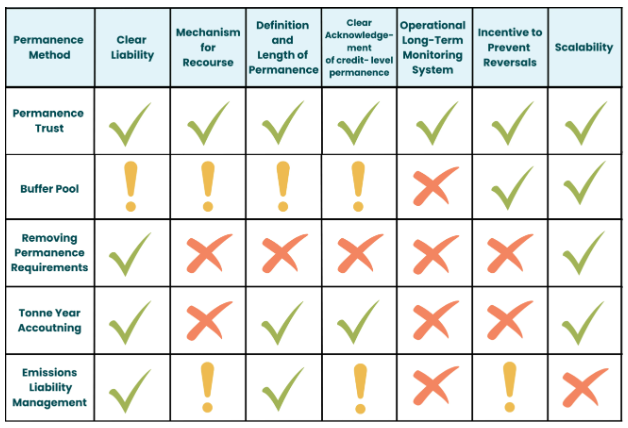
Meanwhile, methods of managing carbon portfolios can still deliver 1000-year permanence through innovations like horizontal stacking (good) and a permanence trust (great). With these innovations, the contract - rather than the pathway - guarantees durability. For some buyers, 40-year permanence can be meaningful because 2050 is in 24 years.
Let's start with basics. Emissions removals are "sucking carbon out of the sky". This means the carbon is already in the atmosphere and the carbon project funds a pathway to remove atmospheric carbon. In order to qualify as a "true removal", the project activity needs to actively remove atmospheric carbon (or other greenhouse gasses and super-pollutants). Things that can remove atmospheric carbon - true removals - are:
That's a lot!
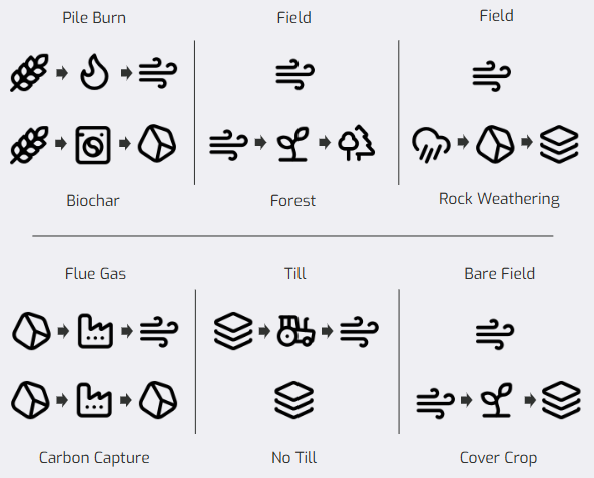
Below are a few pathways that have been rebranded from emissions reductions to emissions removals. These are the "false removals"
Things that don't even help the atmosphere
An easy way to classify carbon projects into removals or reductions projects is to ask one simple question:
Where does the carbon come from?
If your intervention prevents a ton of carbon from leaving a source and entering the atmosphere, you have an emissions reduction project. You are objectively reducing emissions. Period, end of story.
The key is separating the source of the carbon from the destination. The source determines whether you are removing or reducing emissions, and the destination determines durability - how long the carbon will be stored.
One helpful analogy is to compare carbon emissions to your household garbage. Trash collection is an emissions reduction project, and environmental clean-up is a carbon removal project. To *reduce* the amount of household waste that enters the environment, the municipality either provides waste management and trash collection services or requires homeowner communities to purchase and manage their own trash collection service. Even with trash collection, some household waste still slips out of the garbage cans (or doesn't make it into them in the first place), washes down into the storm drain in a heavy downpour, travels down a river, and eventually arrives in the Great Pacific Garbage Patch. Technology that is deployed in the Great Pacific Garbage Patch to *remove* or process garbage is a carbon removal project. The waste is already doing harm and the project cleans up the mess.
Start by reviewing credit ratings from well-established firms like Calyx, Sylvera, and BeZero. Understand that most ratings firms have sectors where they are good at evaluating project quality and risk, and sectors where they are improving. Familiarize yourself with their scientific staff and their pathway review process to determine how biased or impartial their ratings may be. Each specific project should be clear about risks regarding additionality, permanence, leakage, and ability to scale and meet delivery targets. These risks can vary highly even between the same types of projects, and any of them can come back to bite a project when outcomes are verified. Focus on evaluating diverse project types for these risks, and ignore the "Carbon removal" or "CDR" label because it is misleading.
Emissions reductions projects can have tremendous outcomes based on additionality, durability, potential to scale, and leakage risk. Regardless of whether the carbon comes out of the air or is kept out of the air, a ton is a ton. A buyer will be judged based on verified outcomes in the future, regardless of the project label today.
"What are the carbon removal rates in both the project AND the baseline scenarios?"
"How do you observe and verify mitigation outcomes?"
Next in Part 4: Landowner Intent Matters
